When we think about designing initiatives beyond the classroom, education becomes a tool that helps a region better understand itself, align its stakeholders, and communicate its value more clearly and effectively in the market.
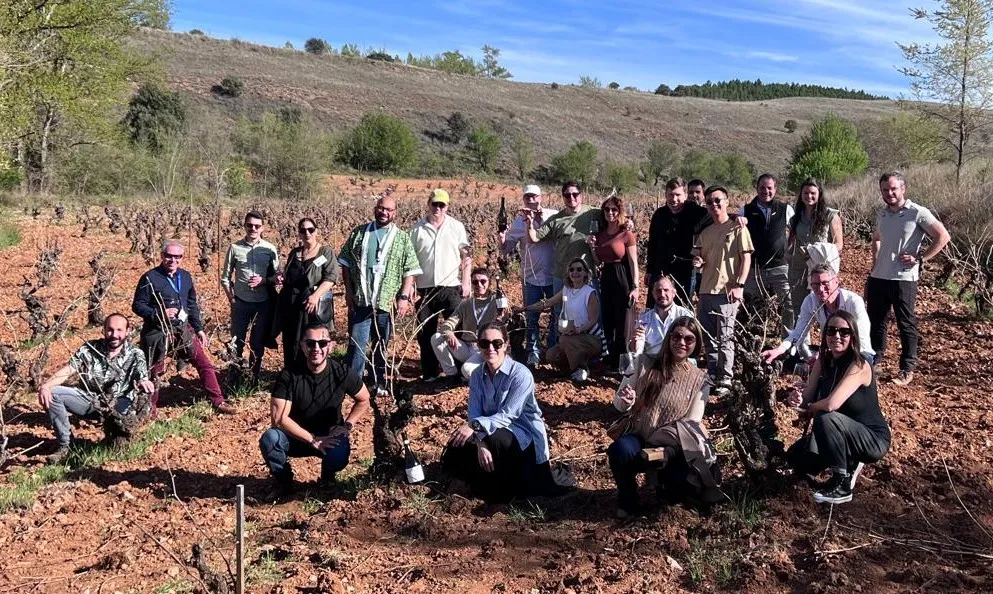
We’ve just wrapped up a very special chapter: supporting the Ribera del Duero Wine Educator programme, a project that has allowed us to work closely with the appellation, its wineries and international educators, with a clear goal in mind: to help Ribera del Duero be better understood, interpreted and communicated across different markets.
This experience also gives us the opportunity to share something that isn’t always visible from the outside: at The Wine Studio, we don’t only deliver official WSET programmes. We also design and support tailored educational initiatives for regions, wineries and regulatory bodies that want to better understand themselves in order to communicate more effectively.
Because education is not just about transferring information. When done well, it becomes a strategic tool.
Connecting what is not always connected
In any regional project, multiple perspectives coexist. There is the Regulatory Council, shaping narrative, identity and positioning. There are the wineries, seeking visibility, return and a coherent role within that shared story. And there is the international market, which receives, interprets and translates that message for very different audiences.
Our role is precisely to bring these realities together.
It’s not just about listening to each party, but about integrating their perspectives into a clear, useful and actionable narrative. One that is not a collection of disconnected voices, but a shared tool for better communication.
Designing education with real impact
When we approach a programme like this, the question is not: “What content are we going to deliver?” The more demanding question is: what value will this programme generate, and for whom?
For wineries, a well-designed programme can bring greater visibility, stronger positioning and access to qualified international prescribers. For a Regulatory Council, it can become a strategic tool to strengthen narrative, differentiation and message consistency. For international educators, it must provide content that is genuinely useful in their day-to-day work.
This is key. Education cannot stop at information. It must help those who communicate a region do their job better the very next day.
From knowledge to tools
Our pedagogical approach always starts with application. We put ourselves in the position of both the sender and the receiver of the message. Because knowing a region is one thing; being able to explain it with clarity, rigour and purpose is another.
That’s why we focus on translating knowledge into practical tools. We prioritise relevance, organise complexity and ensure that every concept has real utility. We don’t want educators to leave with more accumulated information but no direction. We want them to leave with stronger judgement, greater confidence and better resources to communicate.
Content, experience and narrative
A regional education programme cannot be just a sequence of activities. It has to be an intentional construction.
The manual defines the key messages. Tastings make them tangible. Vineyard visits, conversations with producers and on-the-ground experiences help to anchor them. Everything needs to connect: what is studied, what is tasted, what is heard and what is lived.
That coherence is what turns education into a transformative experience—and yes, into something far easier to remember and communicate.
A modern approach to wine education
We believe in education that is rigorous, but not rigid. Technical, but not cold. It needs to be accessible.
Wine is better understood when product, place and narrative are connected. Emotion does not replace knowledge, but it can be a powerful vehicle for learning, remembering and communicating. When a region is experienced as well as studied, the message gains strength.
And in a world full of information, that makes all the difference.
Education as strategy
Supporting Ribera del Duero has reinforced something we have believed for a long time: education can be much more than a one-off action. It can be a positioning tool for a region, a value generator for its wineries and an accelerator of impact for those who will communicate it internationally.
This is the kind of work we are passionate about at The Wine Studio.
Supporting a region does not mean speaking on its behalf. It means helping it organise what it is, understand how it is perceived, identify what it needs to communicate, and build the tools to do so with clarity, authenticity and ambition.
Because understanding a region is only the first step.
Being able to communicate it well is what allows it to travel further.
Congratulations to all the Wine Educators, from whom we have learned so much this year, and to all the wineries of Ribera del Duero that have shared so much with us.
The Wine Studio Team