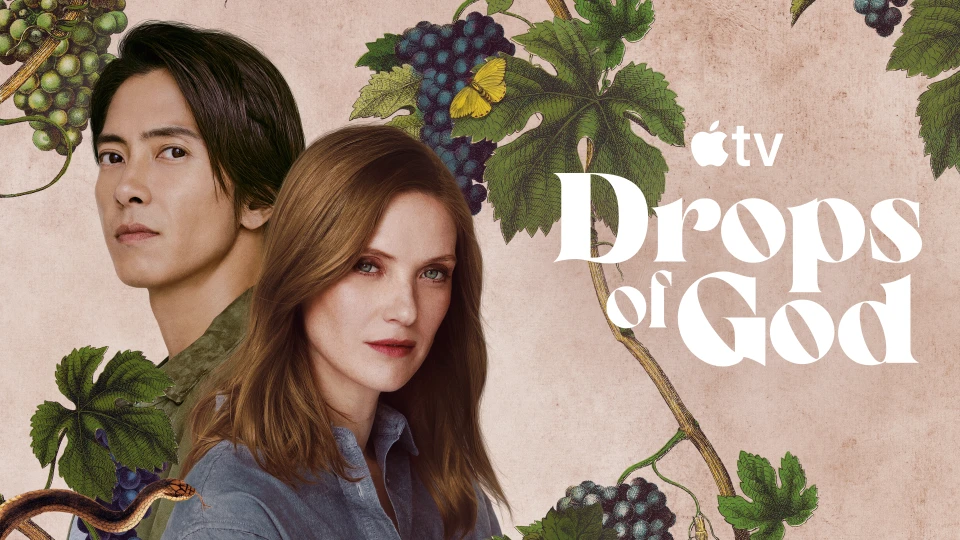
The best wine series ever made — the only one capable of translating onto the screen what truly happens inside a taster’s mind — is back. And it returns with higher ambitions. In its second season, Drops of God (apple TV)definitively leaves behind the territory of playful competition and moves into far more challenging ground: the origin of taste, sensory memory, and the cultural construction of the “world’s greatest wine.”
If the first season was a visual ode to tasting — its metaphors, memories and associations — this new chapter asks a far more complex question, and one that is particularly relevant for you as wine students and professionals:
Does the best wine in the world really exist, or are there only contexts, histories and perspectives? A more mature, more technical, more uncomfortable challenge
Camille Léger (Fleur Geffrier) and Issei Tomine (Tomohisa Yamashita), now fully aware of both their inheritance and their talent, face the final challenge set by their father, the legendary critic Alexandre Léger. A challenge he himself was never able to solve: to uncover the origin of the greatest wine ever made. This is where one of the series’ greatest strengths lies. The quest is not about identifying a mythical label or a legendary vintage, but about understanding the deeper meaning of wine — something that goes beyond technique and enters the realms of anthropology, history and territory.
The journey takes them from France to Spain, from Italy to Georgia, and this geography is no coincidence. It is also a journey through different ways of understanding wine:
From a technical perspective, Drops of God remains unique in one crucial respect that is often overlooked when teaching tasting: tasting is not just a method, it is a language. Once again, the series brilliantly portrays:
For you, #WineStudents, this season is particularly compelling because it challenges the idea of tasting as an exam. Victory does not come from correctly identifying a grape variety or appellation, but from understanding what makes a wine truly great in its time and within its culture.
Territory, history and uncomfortable truths
The inclusion of regions such as Spain or Georgia is far from decorative. With subtlety, the series introduces key concepts that we regularly work on in class:
Georgia is especially telling. Presented not as an exotic curiosity, but as an uncomfortable reminder: long before Parker, before Bordeaux, before the very word “sommelier,” wine already existed — along with culture, ritual and meaning.
Camille and Issei: two ways of tasting the world
If one element truly deepens in this second season, it is the characters themselves — as metaphors for wine tasting. Issei continues to represent tasting pushed to its technical extreme: precision, memory, method. Camille embodies intuition, creative disorder, and the ability to connect wine with life itself. And the series is refreshingly honest: neither is sufficient on their own. As with wine in the real world, excellence emerges when technique and emotion stop competing and start listening to each other.
Drops of God does not teach you how to taste. It reminds you why you started tasting in the first place. Because very few works of fiction have understood so clearly that wine cannot be learned only from books or tasting sheets, but through questions, journeys and — sometimes — doubt. And in this second season, doubt is the real treasure.
Javier Fernández Piera - The Wine Studio